,

My bump, bubs & beyond story

Eighteen years ago (yes, I’m that old!) I was working in sports management for a private company responsible for managing some of Australia’s greatest and most recognisable Olympic athletes and AFL footballers. I was happily married, we’d bought a home, and I was pretty fit. Falling pregnant wasn’t that hard…staying pregnant was!

My first pregnancy lasted only 12 weeks, and I miscarried two-days after we’d told everyone our happy news. I hadn’t even considered it could happen to me! Tears flowed, wine was guzzled and before I knew it I had another “bun in the oven” just 2 months later. This time as you can imagine I was super anxious. Weeks slowly ticked by, we made it to the 12-week scan and all was perfect. We shared our happy news and guess what…a week later I sprung a leak BIG TIME! Blood everywhere, at work, surrounded by stunned (young) male colleagues…SHIT SHIT SHIT NOT AGAIN!

But the little bean growing inside me was a stubborn little thing (still is!) and held on tight. Even though my body kept trying to get him out, he stuck in there. By 23-weeks the little bean was big enough to be viable so into hospital I went and stayed there until little bean was born at 31 weeks. Small, skinny, no suck reflex, but a bloody strong ticker and a good set of lungs.

Eight weeks of daily or twice daily visits to the hospital only to have to leave my baby there, expressing day & night (god I felt like a cow – 100% express feeding will do that to you!) was my introduction to motherhood. Not normal but I didn’t know any different. All my energy, focus and love was being poured into the little bean we named Ben.

Fortunately, Ben thrived once he eventually got home and I dropped expressing – mastitis anyone? I quickly forgot about all of the above and guess what…19 months later we added a bouncing baby girl to our family (yes I was pregnant again before Ben had turned 1!) It was a text book full term pregnancy, natural drug free delivery, no stitches and she was 3.8kg!

Just to keep life interesting, we started a renovation to our little house. Not a room was left untouched. So with a 19-month old toddler and a 10-day old baby (yes 10 DAYS) we moved into my in-laws for 6 months!

A little side-bar here: Up until the first pregnancy, I had “control” over my body. I trained hard, ran harder and faster (or tried to) each session, I was hyper aware of my weight and what my tummy looked like. 3 pregnancies later, little time to recover, less time to exercise and that control I had over my body was gone but not forgotten. I tried gyms, but the kids hated the crèche; I tried running again, but my back didn’t like that (probably my weakened pelvic floor and abdominal separation had something to do with that but I didn’t know anything about those things then), walking with the kids in a double stroller was my sanity, watching (very) closely what I ate was my weight control. (Return to running blog coming soon)

But I digress…the little internal flame for another child was still burning bright. So although I had sworn 2 children was all I wanted, I NEEDED a third! Baby #3 decided to make things a little difficult towards the end of the pregnancy as he (yes, it’s the boys who have caused problems) decided he was pretty happy lying across my belly and wasn’t moving. He wanted to come out the sunroof, not the door! So, c-section it was for #3, followed by wound infection, followed by mastitis…let’s just say with 3 babies & 4 pregnancies in 4 ½ years I was over the whole pregnancy/birth/breast feeding/baby thing and that internal flame was snuffed out!

But as with everything I take on, I threw myself into being a full-time stay-at-home mum but to my own detriment. I felt I had lost me in the process of giving so much of me to them (make sense?) I wanted and needed something where I could just be me, feel good about me, take control again. Eventually I found that in running. The more I ran, the better I felt. The better I felt, the calmer I became, the fog lifted and I was a much happier person/mum/wife. (By this stage I had learned about pelvic floor weakness & abdominal separation and was working on re-building from the inside out.)

So, why am I telling you this? Because we all have scars of motherhood – some visible, some not – and I’m no different. We don’t all bounce back after childbirth, nor should we. And just when you think you’ve got this motherhood and being a woman thing nailed…hormones go bonkers, what was working now isn’t, and you’ve gone back to square one.

I’ve learnt the hard way that we need to be kind to ourselves, allow time to heal, recharge and reflect. Harder & faster is not always better. Make space each day to devote to you – move and nourish your Heart Body & Soul. … little by little…a little becomes a lot xx
,

Mumma-pause

Is this all there is?

So, you’ve just turned 40. Had a big birthday bash to celebrate. Your kids are all at school. The career that you put on hold whilst the kids were little is back on track, and now you have a teeny bit more time for you.

Hang on a sec – what’s that? Did you ask “is this all there is?”

You’ve finally emerged from the fog that descends with the arrival of kids. Now they have grown and are out of the house for a good chunk of each day you have a little more time and space to just be me. Time to see where you are, reflect on who you are and take a little glimpse at what lies ahead. But, have you found yourself asking “is this all there is”?

Guess what ladies, what you’re feeling has a name “mumma-pause” – an amazing period of transition in your life when you get to be a little selfish. Reinvent yourself if you really want to. The best bit – by now you’ve grown a pretty thick skin so you really don’t give a SHIT how silly you look whilst doing it.

Here are 5 signs that you may be experiencing “mumma-pause”:

  1. After years of the same hairstyle, you’ve had a savage new haircut or colour change.

Guilty! We all gasped when Carrie Bickmore turned brunette overnight. Well I’ve gone the reverse and I’m nearly blonde, mainly due to the fact I’m trying to camouflage the greys that are taking over.

  1. Where once a jog around the block or a hit and giggle with the girls at tennis was enough exercise for a month, you’ve developed a sudden interest in intense exercise.

Well this is nothing new to me, and I even ran my fastest marathon at 41. BUT I have been trying a gazillion different forms of exercise from hot yoga to CrossFit, to triathlons and ocean swims and I hate swimming!

  1. That gaping hole left by the kids not being around during the day has been filled with the purchase of a puppy or a kitten, or both.

I threatened for years to add another dog to our family, and just over a year ago I did! We added Billie the spoodle to the tribe.

  1. You’ve gone back to uni or taken up studying.

That under grad, post grad or TAFE course you always wanted to do but never had the time or money is now possible. I’m the perfect example of this as since turning 40 I’ve completed Certificate 3 & 4 in fitness, 1 semester of a post grad in Human Nutrition, countless professional development on-line and weekend courses including further education in Safe Return to Exercise, women’s health and post-natal exercise.

  1. Turned a hobby into a business.

Hello Heart Body & Soul!!

Ladies, you’re not alone in your mumma-pause. You can follow my mumma-pause journey on Facebook or Instagram, and see just how much reinventing I’m doing AND laugh at how silly I look whilst having a blast doing it!

Jac x

,

The Ageing Brain & Exercise

whats-your-excuse-fitness-motivation-triumphExercise – training for your body & brain!

We all know that exercise is good for your body – protecting you against diseases and conditions related to ageing. The good news about exercise doesn’t stop with the physical benefits though. More and more research is discovering that exercise has a positive effect on our brain and slowing the cognitive decline usually associated with ageing.

Thanks to Dionne for sharing her expertise in this area. A really interesting snapshot article from a fellow metafitter who practices what she preaches!!

Exercise has been known for years to be advantageous to cardio-vascular health, protecting against diseases associated with ageing. There is increasing evidence to suggest that exercise benefits age related and neurobiological cognitive decline. BUT the question is how much, how long and how often and what intensity is required to be beneficial? Is more, really more? In the face of such public uncertainty and debate, researchers have been eager to answer these questions!

Data collected from animal models suggest that cardiovascular fitness training (CFT) directly correlates to improvement in cognitive performance. In animals, aerobic exercise has been found to increase brain- derived neurotrophic factor (BDNF) levels and other important neurochemicals. This increases neurological survival and new neuron development. This means that the brain is more efficient, plastic and adaptive, which results in better learning and performance in adulthood.

Physical exercise, but not spare-time activity, at 36 years was found to be significantly associated with a slower rate of decline in memory from 43 to 53 years, after controlling for the same factors. Those who engaged in physical exercise showed on average a half-point slower decrease over those who did none. Those who gave up exercising after 36 years did not show the same benefit as those who were exercising at 43 years, either new or continuing. The results suggest that continued engagement in physical exercise slows down the rate of memory decline and that cognitive benefit of physical exercise is enhanced by persistent or more recent activity.

Further studies have also suggested that interval training increases in circulating growth factors is connected to temporal lobe functional brain connectivity in healthy older adults. Future research could focus on discovering that Metafit with its short duration and intensity would provide optimal changes in growth factors and how it may be beneficial to cognition and disease progression.

GO METAFITTERS!!!!

Dr Dionne Shnider
Ph.D. APCCH;M.A.P.S
Psychologist and Clinical Hypnotherapist
Provider no. 2713214W

,

Metafit for the midlife mumma?

Are you a 40+ female and looking for a new way to exercise that is short on time but big on results? If yes…read on!

If you’ve clicked on this post I’m going to presume you meet the following criteria:

  • Female
  • 40+
  • Currently exercising but not seeing results for the time or money you are devoting to it OR
  • Not exercising but would love to/need to start, but you don’t like gyms, and yoga and/or pilates don’t float your boat either OR
  • You feel a little intimidated to sign up to boot camp run by a 20 year old male trainer alongside his footy team-mates, but you love the idea of working hard and feeling the buzz after a tough session

If any of the above sound like you, then please read on…

OK, so I’m no stranger to pushing my body (& mind) to do heavy-duty physical things…in fact I met my hubby whilst sharing the chin-up bar at the gym!…so when I was introduced to METAFIT it was love at first sight! But doing old-school bodyweight exercises in short, intense bursts for 20 minutes until your legs are burning and you’re gasping for breath isn’t for everyone…or is it?

For the past 18 months I’ve been taking 7 metafit sessions a week. The overwhelming majority of my clients are women, and most of them would be north of 40 (or pretty close to). So why is metafit so attractive/addictive to the 40+ woman?

Here’s what I think:

It’s the RIGHT type of exercise for this age group (and I fit into this age bracket too). What do I mean by RIGHT type of exercise? Its INTENSE but SHORT, you feel ENERGISED afterwards and you GET RESULTS.

HOW? Because you:

  • Get HOT
  • Get SWEATY
  • Get OUT OF BREATH
  • Feel the LACTATE BURN in your muscles
  • Work in SHORT BURSTS
  • Work until you FEEL TRULY CHALLENGED and NEED TO REST
  • Use your own BODYWEIGHT – yep, the same weight that you drag around each day so you may as well use it!
  • FEEL yourself getting STRONGER and FITTER as you master exercises you thought a 40+ woman can’t/couldn’t/shouldn’t do! (Floor to sky tuck jump anyone?)

WHY should a 40+ woman do metafit or HIIT?

  1. BONE HEALTH – weight bearing and impact exercise are essential for bone health and maintaining bone mass at this critical phase of life. After the age of about 30, bone loss starts to outpace bone gain. In addition, the decline in oestrogen production that also occurs as we age has a negative impact on bone remodelling activity. Bone mass is reactive, not proactive. Bone must experience stress ie. load and impact, in order to remodel. Less stress = less remodelling = loss of bone mass.
  1. To build LEAN MUSCLE MASS (notice I say mass and not size) and therefore INCREASE YOUR METABOLISM – muscle tissue = metabolic tissue. The more (dense) muscle you have the higher your metabolic requirements – your body needs & will use more energy whilst at rest compared to someone who has less lean muscle.
  1. The high intensity of metafit promotes EPOC (excess post-exercise oxygen consumption) or the afterburn effect. Our bodies want to return to their resting state, but after being worked so hard during high intensity exercise, it takes considerable energy (calories) to do this. Even though the actual workout is only 30 minutes, the after effects are felt for many hours (up to 48hrs) afterwards.
  1. To MAINTAIN or INCREASE MOBILITY, BALANCE & POSTURE – the whole body functional nature of the exercises used in metafit see you getting up and down from the floor, moving forwards, backwards, sideways, using your arms and legs to push, pull, bend, lift, jump, hold etc through a full range of movement in all joints. At the same time your core & postural muscles are working to stabilise your torso and maintain posture. And the resistance is your own body – the same weight you drag around all day – nothing more, nothing less.
  1. Check the strength and integrity of your CORE & PELVIC FLOOR. If you find when you do burpees, sprints or jumps and pee your pants at ANY level…fantastic! This is 100% proof that your core/pelvic floor isn’t up to par for this type of training…yet. If this is you, please seek assistance from a specialised women’s health physiotherapist or your GP ASAP. Just like any muscles, these muscles can be trained to increase their strength and tone and your ability to control them. (Sometimes we need to experience a little of what we don’t want to do something about it!)

Are you a metafit or HIIT convert? How do you find it?

Curious to try? Come and join me at Heart Body & Soul in Glen Iris. You’ll find the timetable here. If you live a little too far away to visit me, search the Metafit Australia website for a coach near you.


,

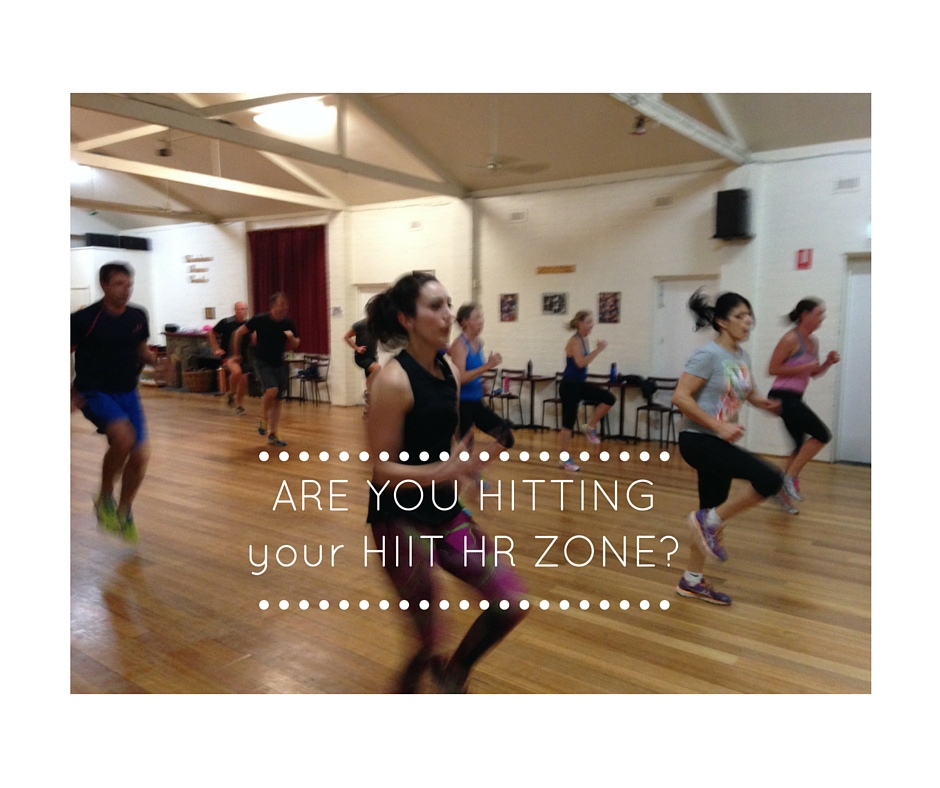
Are you hitting your HIIT Heart Rate zone?

Heart RateMetafit HR Training Zone – what is it & how to calculate it.

HEART RATE (HR) & INTENSITY – after a recent metafit session we had a little discussion about heart rate – what is the ideal HIIT or metafit HR training zone, how do you calculate Max HR and then training zones, my HR says xyz, is that good? etc – which prompted me to write this post. As lots of you have Fitbits or Garmins and the like with HR monitors built in – you may as well put them to good use! Here’s a little Heart Rate & Intensity 101…let’s put those fancy wrist adornments to work!

HEART RATE (HR) – the number of times your heart beats in a time period – we usually use a minute – and the unit of measure is BPM (beats per minute). With exercise your HR elevates as the heart works harder and beats faster to pump more blood around the body, to fuel the working muscles with oxygenated blood and remove waste products.

INTENSITY – this is a measure of how hard the body is working whilst exercising. Rate of Perceived Exertion (PRE) is the subjective scale you apply to measure intensity – for example going for a walk is probably a 2-3 out of 10 on a scale of 1 (super easy) to 10 (about to die hard!). HR is a measure of exercise intensity. The higher the HR or beats per minute, the higher the intensity or harder you are working.

MAXIMUM HEART RATE – This is the maximum your heart rate will reach during maximum physical exertion – beyond this you may run into problems. This number differs across age groups, physical fitness and genetics. For example a highly trained 45 year old will have a higher max HR to an untrained 45 year old. The standard formula for calculating Max HR is:

220 – your age = Max HR

Once you know your Max HR, you can then calculate the heart rate zones you should be working within to achieve the desired fitness outcomes of your training.

METAFIT HR TRAINING ZONE & INTENSITY – the ideal heart rate zone to be working within to get the most out of a metafit session is 80-85%. This is high when compared to moderate intensity endurance training, but that is why its called HIIT (HIGH INTENSITY interval training). Let’s use me as an example, my metafit HR training zone is:

220 – 45 (age) = 175 (my Max HR)
175 x 80% = 140
175 x 85% = 148.75
Metafit training zone: 140-150BPM

So, get the calculator out, calculate your Max HR and then your metafit training zone. Next time you do a session and you have your HR monitor on – keep an eye on it during the session and see if your perceived rate of exertion matches the actual HR you are working at.
I’d love to hear how you go – does your mind say you are working harder than your heart OR vice versa?

,

Spring into September


3-steps to spring into September

Spring into September

Spring…a time for new beginnings, a fresh start, a clean slate, a new wardrobe! Yes, we can (finally) leave winter behind and say a cheery Hello to longer days, brighter sunshine, and bare legs…well eventually (hopefully)!

So, just as a good spring clean for the house is on the to do list, I’ve also put together a little 3-step “spring into September” challenge. Not one of those nasty physical challenges that has you doing a gazillion burpees by the end of the month. This one has more of a recalibration feel to it…a shedding of the winter woollies and getting your butt into gear before we start singing Christmas carols and talking New Years resolutions.

3-steps to “spring into September”

  1. Move Daily

OK, so I know we all move daily – but I’m talking the type of movement that takes you further than the couch, fridge, office & car. MOVE for about 20 minutes a day – walk, swim, jog, ride, play tennis, play with the kids down the park, walk to school pick-up, try yoga or pilates – JUST MOVE.

  1. Eat Real Food

When trying to come up with a cool catchy phrase I couldn’t think of anything else but this. If you’ve been following me for a while, you’ll know I don’t subscribe to any fad diets, I just eat & promote wholesome, tasty, nutritious REAL food and keep it simple.

Here’s a few examples:

  • Home-made pizza over take away pizza – you get to choose your own toppings and its probably cheaper
  • 1 or 2 pieces of fresh fruit instead of a Boost Juice – definitely cheaper, will fill you up and give you an extra 10 -minutes in your day as you don’t have to wait in a queue
  • Salad & protein for dinner – so simple its ridiculous. Throw together a combination of anything you have in the crisper or pick up a few bits on the way home, add some feta, drizzle over some olive oil & freshly ground pepper and you have a salad. Serve that with a piece of steak, chicken or fish and you have just about the perfect balance of macro & micro-nutrients on your plate.
  • Eggs – cooked how you like, served with what you like, a complete meal in under 10 mins
  1. Connect socially

Social interactions and relationships are vitally important to our emotional and mental health & well-being. By connect I don’t mean via social media or electronically. I mean REALLY CONNECT – pick-up the phone and call a friend. And just talk. Make time to meet for coffee or lunch or breakfast or dinner. Go and visit your parents, grandparents, elderly relatives. Walk across the road and say Hi to a neighbour. Put screen devices (large & small) away/off at meal times and connect as a couple/family. Plan date nights with your partner, and girls/boys nights with your friends. Sounds like a fun month ahead!


So there you have it. It’s a tough challenge (!) but if you stick with it, you will be skipping and hopefully smiling into October.

Have fun

HB&S icons-19_web


Jac xx

, ,

HIIT Workout for @ home or hotel

The latest DIY HIIT workout for @ home or the hotel room

One of the (many) brilliant things about HIIT bodyweight training is that a workout can be done anywhere at anytime – all you need is a little space, a clock with stopwatch or interval timer app, and a little self starter attitude.

The latest workout attached will take no more than 15 minutes including a warm-up!

So, what are you waiting for HIIT IT!IMG_0316.CR2

Hotel HIIT Workout #4

, ,

Metafit for mums to be

Ok, so you’ve heard that Metafit is suitable for all thanks to the adaptability of the exercises – but what about for the pregnant client? A qualified Metafit coach can regress or progress each exercise to suit their client’s level of fitness, range of mobility – particularly if limited due to pre-existing conditions, and strength. The normal path is that we start with the regression and then progress as the client’s fitness and strength improves, but with a pregnant client this moves in the opposite direction.

“Pregnancy and Metafit- you wouldn’t think that they go together, but after support from my obstetrician and trainer Jacqui I have found metafit to be something that I look forward to as part of my regular routine.

Initially I was sceptical in thinking that I would be able to continue as I started to grow; thinking that Metafit would become less effective.  But as I am nearing the end of my pregnancy I have actually found my strength to increase and my control of each exercise improve as I strive to have the correct technique. My favourite part of Metafit is the endorphin rush after the final countdown on the finisher from Mr Metafit!

Thank you to Jacqui for reigniting my passion for exercise and I know if this baby can’t sleep it will be because it is missing the feel of burpees and squats!” Marie, Glen Iris

Let’s consider exercise during pregnancy. Physical activity and reproduction are normal parts of life. Pregnancy is a normal physiological state – ok so not all women have “normal” pregnancies (me being one of them!) – but the female species has been designed to conceive, grow and deliver a baby. Combining regular exercise and pregnancy for normal healthy women appears to benefit both the mother and baby in many ways:

  • Improve maternal fitness
  • Restrict weight gain without compromising fetal growth
  • Hasten postpartum recovery
  • Reduce risk of developing gestational diabetes
  • Improve self esteem and mental well being

Risks? Currently there are no known adverse risks to a pregnant woman or the developing fetus that are linked with participating in physical activity. However, as pregnancy progresses, the body goes through significant changes such as increased looseness of joints, changes in centre of gravity and an increased resting heart rate. Therefore, modifications to any exercise program need to be considered as the pregnancy continues.

Considerations – while most forms of exercise are safe, there are some general cautions:

  • Avoid raising body temp too high – interestingly adequate hydration, regular exercise and pregnancy combined can all improve a woman’s capacity to dissipate heat.
  • Don’t exercise to the point of exhaustion
  • Avoid exercise if ill or you really don’t have the energy – listen to your body to avoid depleting precious energy reserves
  • Don’t increase the intensity of your exercise whilst pregnant – pregnancy is not a time to try and set a new PB or reach peak fitness!
  • PELVIC FLOOR health is vital. As pregnancy progresses and the pelvic floor muscles come under greater load and stretch, reduce impact to reduce strain on pelvic floor.

METAFIT & the mum to be

In its purest form, Metafit is high intesntiy interval training (HIIT) – pushing yourself to work at 85% max heart rate. It is also bodyweight training, using functional whole body exercises that work joints and muscles through their full range of mobility.

So for a pregnant client, we regress Metafit – reduce the intensity, reduce the impact, modify exercises to accommodate the changes in centre of gravity and of course being prone/supine. Although not really a HIIT session in later pregnancy, Metafit is still a very useful program for the pregnant client as she is completing weight-bearing exercises, working aerobically, and exercising under the supervision of a qualified fitness professional. Effective, efficient, functional training.

Ultimately, exercising whilst pregnant is a personal choice often determined by the health of mother, baby and progression of the pregnancy. Doing any physical activity is better than none. Listen to your body – if it likes what you are doing, keep doing it. If it tells you to slow down, slow down. When in doubt, seek the help of a professional. The goal is for a healthy mum to deliver a healthy bub!

Putting the spring in your step…..and a smile on your face – a little physical activity each day is good for your Heart Body & Soul.


, ,

Focus on landing

Soft landings = safe landings

Metafit uses plyometric exercises (eg. jumps) to build strength and power. When performing plyometric exercises, landing technique is often overlooked, but it is AS if not more important than the concentric (upward) motion of jumping.

The untrained way to land is in a very rigid, stiff legged manner. As a result, all of the impact is absorbed between the hip, knee and ankle joints. It is much more advantageous to land softly and transfer the force to the glutes (butt), hamstrings, quads and calf.

One of the recent points of discussion in strength and conditioning communities focussed on people who are quad dominant v glute dominant. Quad dominant athletes tend to use their quads to shift their weight forward with squatting and jumping movements. This not only transfers a lot of pressure to the front of the knee, but puts a large load on the anterior cruciate ligament (ACL).

By learning how to land softly without noise and controlling deceleration, you will significantly lower the impact forces, decrease the risk of injury and extend the life of your joints.

The key points in landing technique are:

  1. Land as softly as possible, making no noise when the feet come into contact with the surface. How many times have you heard me say “Absorb the impact through your butt and thighs, not your joints”!
  2. Land flat footed or slightly heel first, keeping weight evenly distributed over the entire foot.
  3. Shift your glutes or butt back and keep your knees behind your toes. “Butt out”

Jumping and landing training are highly demanding on the nervous system, so it is essential that the body is warm enough to perform the exercises efficiently. Please practice these key points when performing jumps in a metafit session – your joints will thank-you.

, ,

High Intensity Interval Training (HIIT) 101

High Intensity Interval Training – in words & pictures

Here it is, the Complete Guide to High Intensity Interval Training – the training principle that METAFIT is built on. After reading this you’ll understand what HIIT is, the science behind it, examples of some of the different methods and protocols, and if you’re super keen how to do them yourself. Thanks to my friends at Greatist.com

The Complete Guide to Interval Training

More Health and Fitness News & Tips at Greatist.