Posts

, ,

Stress – the good, bad and the ugly

Is the feeling of being “tired but wired” familiar to you?

Or maybe you are on the “coffee, chocolate & wine” diet. You NEED a coffee to wake up. At 3.30 the afternoon slump hits and you seek out chocolate for a quick pick-me-up, and then a sneaky wine or two at night to help calm you down and fall asleep.

Squirming a little?

Let’s talk about STRESS today as nothing stuffs your hormones, health or happiness faster than unmanaged or chronic stress.

But first – I want to stress (ha ha) that not all stress is bad. In fact, a healthy dose of stress is needed to motivate you to perform and work at a high level.

The key is to manage your stress so that it doesn’t spiral out of control and set off a series of health issues and hormonal chaos.

I’d like to introduce you to CORTISOL – one of the main stress hormones (the other being adrenaline).

Cortisol receptor cells are found in almost every cell in the body, therefore this hormone can have a number of different actions depending on which cell it is targetting. Cortisol plays a role in:

  • Controlling blood sugar levels
  • Regulating metabolism
  • Acting as an anti-inflammatory
  • Influencing memory function
  • Controlling water and salt balance
  • Influencing blood pressure
  • Sleep/wake cycles
  • Digestion
    …to name a few!

Poor old cortisol gets a bad rap, but as you will soon see it is the chronic activation of the stress response that is the issue.

I could get super nerdy and detailed about the stress response, but let’s keep things simple. Here’s a brief explanation of the “fight or flight” stress response.

Your senses detect a potentially life-threatening situation that the brain interprets as “danger”. In response to this acute stress, the branches of the autonomic nervous system (sympathetic and parasympathetic systems) work in tandem, together with the hormonal system and set off a series of reactions we call the stress response.

In reaction to a stressor, the sympathetic arm – let’s call it the accelerator pedal – will initiate the “fight or flight” response. A series of messages stimulate the release of hormones, one being CORTISOL, and the body is activated to protect us from the danger by preparing us either to stay and fight or to get away as fast as possible – we become faster, stronger, and have more endurance for a short time.

Once the stressor has passed, the parasympathetic arm – or the brake pedal – promotes relaxation and recovery and brings the body back to its normal state.

This reaction is healthy and beneficial when it is turned on AND off.

The challenge is that for many people the accelerator pedal is always on, keeping the engine revving too high. This is CHRONIC stress and the cortisol surge never turns off. This can lead to elevated cortisol, or it may cause your cortisol levels to swing wildly between too high and too low – sometimes within hours of the same day!

Hello hormone imbalance!

The problem is that your body does not know the difference between physical & mental stress, actual or perceived stress, and it triggers the same physiological response.

Unfortunately, the body can overreact to stressors that are non-life-threatening, such as traffic jams, work pressure, family or relationship difficulties, even perceived stressors that don’t exist, except in our imagination, too much intense exercise without sufficient recovery, extreme dieting…

The more stressors, the greater effect on the nervous system. If the individual cannot remove the stressors the more dominant the sympathetic nervous system becomes.

Long-term effects of chronic stress have been linked to:

  • High blood pressure
  • Diabetes
  • Increased belly fat
  • Changes in the brain, particularly the hippocampus which is the memory centre
  • Insomnia
  • Immune system dysfunction
  • Inflammation
  • Osteoporosis
  • Depression
  • Anxiety
    …wonderful hey!

The GOOD news is, however, that with a few tweaks to your lifestyle these effects can be halted or even reversed by managing your stress levels and finding the “Goldilocks” level – not too high and not too low – for cortisol.

Here are 3 strategies to start feeling a little more relaxed…

  1. MOVEMENT

Find something that you LOVE to do, that takes you outside, that gets the happy hormones flowing. Yoga, dancing, zumba, swimming, walking, LISS (low-intensity steady state cardio), pilates. ANY movement that leaves you feeling better than before you started.  **Beware of adding to your stressed state with too much high-intensity exercise.**

2. MINDSET

As women and mums, we are very good at trying to be everything to everyone, feeling guilty when we fall short of our own expectations and “not enough”. Working on your mindset, practicing self-compassion, choosing to do less to achieve more, will all go a long way to relieving the feelings of stress and anxiety that build up, keeping the accelerator pedal down and the engine revving.

3. MINDFULNESS

Mindfulness is a form of self-awareness training. Mindfulness is about being aware of what is happening in the present on a moment to moment basis, and not making judgments about whether we like or don’t like what we find. When we focus on the present and disengage from mental clutter, it allows us to have a clear mind. It makes it possible for us to respond rather than react to situations, and therefore improve our decision-making and potential for physical and mental relaxation. Ahhh!

Do you need to press PAUSE and take your foot off the accelerator? Then I’d love you to join me at our next mmmPower Your Heart Body & Soul workshop where we focus on the three m’s above – Movement, Mindset & Mindfulness.

WHEN: Monday 18th June
TIME: 7.30pm – 9.30pm
WHERE: The Swedish Pilates Studio, Glen Iris
BOOKINGS: Click HERE (you’ll be taken to Mindbody)
FURTHER INFO: jacqui@heartbodyandsoul.com.au
,

Readiness to Train

“As we warm-up, do a scan of your body. How do you feel today? Stiff or sore from Monday? Work and modify the exercises for how you feel today.”

Have you heard me say and ask this before? By being able to identify with how you and your body “feel” on any particular day, and then modifying how you train is one of the best ways to honour your body and get the most out of not only that day’s training, but your training in general.

Using a daily readiness scale is a simple way for you to track how different lifestyle choices and behaviours impact on your overall wellbeing, and therefore assist you to make the necessary tweaks to help you achieve greater benefits from your fitness program.

Your daily readiness score provides valuable insight into how various physical, emotional, psychological and lifestyle stressors impact you and your body. There are no hard and fast rules or “one size fits all” approach for training intensity as it all “depends” on so many different factors – gender, age and goals to name just a few. I believe the best approach for the everyday athlete – like you & me – is to honour how you feel, and if you want to get a little more techo, track your heart rate (HR) to monitor intensity and recovery through your workout.

Why measure?  We have been conditioned to think that “more is better” and “harder & faster” or “go hard or go home” is the way to approach each and every training or fitness session. But in reality, training an already “stressed” system too hard will see results plateau or reverse, and only increase the stress on an already inflamed body. Pushing through when your body and your emotional state is already in “fight or flight” mode and unable to cope will take you further away from your goals than towards them.

So, with that in mind and to help you quantify your readiness to train, I’d like to introduce to the Daily Readiness Scale as developed by PTA Global. This scale gives you an honest and solid indication of how hard you should train on THAT day, if at all. Simply answer the questions honestly and tally up your score. Once you know your readiness score, you make a few subtle tweaks to your workout to give you the best chance of improving your outcomes.

Give yourself 1 point for each you have done well:

  • I slept well and feel rested
  • I have fuelled my body with good nutrition
  • I have hydrated with 2+ litres of water
  • I have moved well and often in the last 24 hours
  • I feel energised and strong
  • I have no pain or stiffness
  • I feel emotionally happy and clam, not stressed
  • I feel mentally ready and motivated to train

What your score means:

GREEN 6-8 out of 8 – You are good to go!

AMBER 3-5 out of 8 – Caution! Reduce the intensity or weight today

RED 1-2 out of 8 – Take it very easy today

For example, if you scored in the red zone thanks to doing too much, eating poorly and not allowing for sufficient recovery in your life – then make your training session one that focuses on restorative movement or an activity that makes you feel better than when you started. And if stress and emotions are running hot, then reduce the stress & intensity in your session (stay out of the red zone!), and focus on play, movement and recovery. If you score in the amber or caution zone as you’ve pulled up a little sore & stiff, then employ strategies that will help you move more efficiently – lower impact, full range of movement, less is more.

And finally – the best way to increase your readiness score and boost your overall wellness is to try and tick all the boxes by looking after the 4 big rocks:

  • SLEEP – Prioritising good quality sleep
  • STRESS – Understanding how stress affects you and what strategy is needed to reduce its impact on your body
  • NUTRITION – Hydrating and nourishing your body with foods that serve you well
  • MOVEMENT – Move daily, decrease time spent sitting and find purposeful “exercise” options that you ENJOY doing

A little more on the BIG ROCKS to come soon!

How ready are you to train today?

,

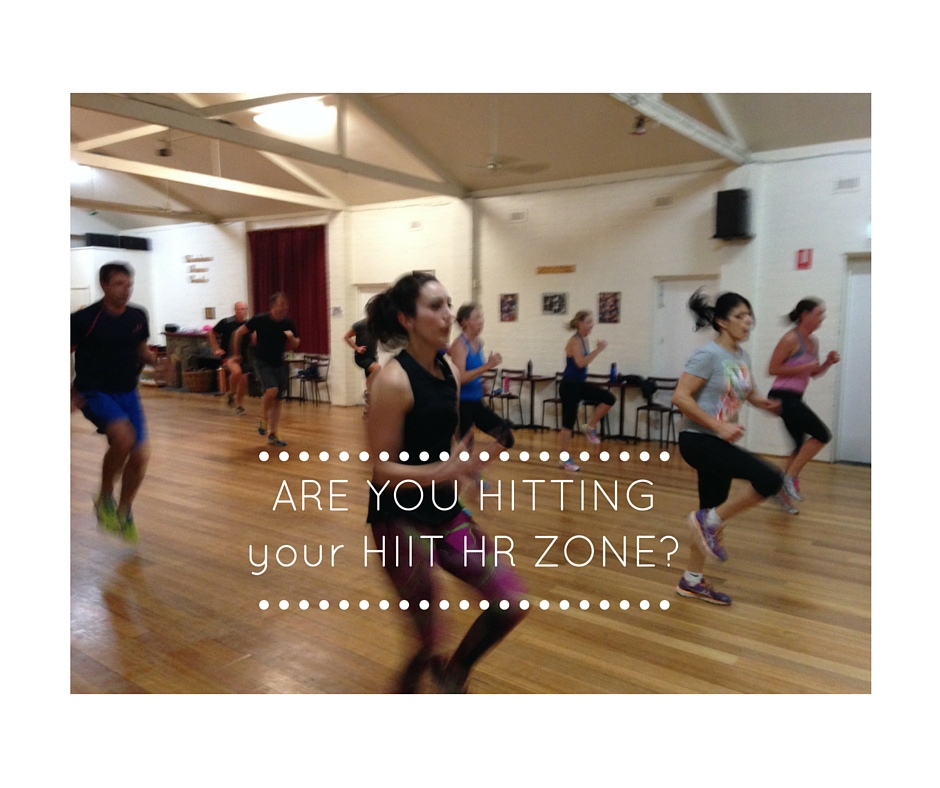
Are you hitting your HIIT Heart Rate zone?

Heart RateMetafit HR Training Zone – what is it & how to calculate it.

HEART RATE (HR) & INTENSITY – after a recent metafit session we had a little discussion about heart rate – what is the ideal HIIT or metafit HR training zone, how do you calculate Max HR and then training zones, my HR says xyz, is that good? etc – which prompted me to write this post. As lots of you have Fitbits or Garmins and the like with HR monitors built in – you may as well put them to good use! Here’s a little Heart Rate & Intensity 101…let’s put those fancy wrist adornments to work!

HEART RATE (HR) – the number of times your heart beats in a time period – we usually use a minute – and the unit of measure is BPM (beats per minute). With exercise your HR elevates as the heart works harder and beats faster to pump more blood around the body, to fuel the working muscles with oxygenated blood and remove waste products.

INTENSITY – this is a measure of how hard the body is working whilst exercising. Rate of Perceived Exertion (PRE) is the subjective scale you apply to measure intensity – for example going for a walk is probably a 2-3 out of 10 on a scale of 1 (super easy) to 10 (about to die hard!). HR is a measure of exercise intensity. The higher the HR or beats per minute, the higher the intensity or harder you are working.

MAXIMUM HEART RATE – This is the maximum your heart rate will reach during maximum physical exertion – beyond this you may run into problems. This number differs across age groups, physical fitness and genetics. For example a highly trained 45 year old will have a higher max HR to an untrained 45 year old. The standard formula for calculating Max HR is:

220 – your age = Max HR

Once you know your Max HR, you can then calculate the heart rate zones you should be working within to achieve the desired fitness outcomes of your training.

METAFIT HR TRAINING ZONE & INTENSITY – the ideal heart rate zone to be working within to get the most out of a metafit session is 80-85%. This is high when compared to moderate intensity endurance training, but that is why its called HIIT (HIGH INTENSITY interval training). Let’s use me as an example, my metafit HR training zone is:

220 – 45 (age) = 175 (my Max HR)
175 x 80% = 140
175 x 85% = 148.75
Metafit training zone: 140-150BPM

So, get the calculator out, calculate your Max HR and then your metafit training zone. Next time you do a session and you have your HR monitor on – keep an eye on it during the session and see if your perceived rate of exertion matches the actual HR you are working at.
I’d love to hear how you go – does your mind say you are working harder than your heart OR vice versa?

, ,

HIIT Workout for @ home or hotel

The latest DIY HIIT workout for @ home or the hotel room

One of the (many) brilliant things about HIIT bodyweight training is that a workout can be done anywhere at anytime – all you need is a little space, a clock with stopwatch or interval timer app, and a little self starter attitude.

The latest workout attached will take no more than 15 minutes including a warm-up!

So, what are you waiting for HIIT IT!IMG_0316.CR2

Hotel HIIT Workout #4

, ,

DIY HIIT Workout #5

TABATA – 4-16mins of HIIT

Tabata – is the name given to an exercise protocol developed by Prof. Izumi Tabata in a study he completed using Olympic speedskaters in 1996. The protocol is a version of HIIT (High Intensity Interval Training), 20 seconds of ultra-intense exercise followed by 10 seconds of rest, repeated for 4 minutes. The basics of this protocol are used in a variety of HIIT sessions, but in its purest form participants work at 150% Max HR for 4 mins total!

In this DIY workout YOU can be the coach – you get to choose how many Tabtata sets AND which sets to do. Each set is 4 minutes duration, alternating between 2 different exercises – 20 sec on A, 10 sec rest, 20 sec on B, 10 sec rest REPEAT.

As with all HIIT sessions, a thorough warm-up is essential, as is working HARD in each interval – you need to be huffing and puffing, NO PACING and GREAT TECHNIQUE. Exercise descriptions follow and the exercise basics can be found here

Warm-up:

Arm circles – back/forwards

Leg Swings – fwd & back, side to side

Trunk rotations

10 Body weight squats

5 Push-ups from knees

Jog on spot – butt kicks 15 sec, high knees 15 sec, sprint 15 sec – x 3 each

Main HIIT set:

TABATA – 20 sec work/10 sec x 8 = 4 mins per set

20 sec on ex A, 10 sec rest, 20 sec on ex B, 10 sec rest – REPEAT

30 sec rest in between sets

Set 1 A. Sliders/Skater B. Mt Climbers
Set 2 A. 2-step dash B. Crucifix plank
Set 3 A. Burpees B. No-wall sit
Set 4 A. Sprint B. Split hand push-ups


Sliders/Skaters –
Lower into squat position, step sideways keeping weight in heels and butt back, bring feet together, step to other side, feet together. Repeat. Stay low, head & chest up. 

Mt Climbers – In plank position (shoulders over wrists, heels over toes), bring one knee up to chest, return to plank position, repeat other side.

2-Step Dash – Run forward 2 steps, touch flat palm to ground, run back to steps, flat palm to ground. Bend at knees to keep butt down, squeeze butt to stand up, use arms in run phase.

Crucifix plank – wide arm plank, feet together, squeeze shoulder blades together

Burpees – old fashioned burpee. Hands on ground, jump feet back to plank position, jump feet in to hands, stand/jump up explosively with arms raised overhead. Repeat.

Split hand push-ups – One hand forward, one hand in normal push-up position, push-up, change hand position, repeat. From knees alternative.

Sprint – sprint on spot, high knees, pump arms

No-Wall Sit – Hold static squat for 20 sec. Butt back, weight in heels, head & chest up.


Cool Down:

Static stretches that target quads, hamstrings, hips, groin, lower back


,

Metafit – Child’s play for lasting benefits

Metafit – for a  long, healthy life

A metafit session may not be child’s play, but it does involve playful movements such as jumping up and down or standing on one leg, things we often leave behind with childhood. Yet these movements can benefit a grown-up’s body. Jumping can strengthen bones, and standing on one leg improves balance.

You don’t need to come to a metafit session to do either of these movements, but if you do come to metafit I guarantee you will do things you didn’t know you could (still) do. So, if its been a while since you jumped, stood on one leg or went outside your comfort zone, these are some of the reasons to give metafit a go.

A decade ago, a typical cardiovascular class (aerobics class) at a gym often involved so many choreographed moves you almost needed brains in your feet as well as your head. Now the trend that metafit leads is to less complex exercises that improve all-round physical function – not just aerobic fitness, but muscle strength, power, flexibility and bone density.

Old-school basic training, with movements such as push-ups, tuck jumps and burpees. Yes BURPEES – where you squat on the ground with your hands on the floor and kick your feet back so you are in a push-up position. Then jump your feet back into the squat position, jump up in the air and do it all again.

What is good about these movements is that, although they take effort, they are not complicated to do and, because you move quickly from one to another, there is no time to get bored.

“Traditional classes like step or aerobic classes have waned and I think its because the complexity of the choreography often compromised the physical benefits you got from them,” says Alisha Smith, education manager with Australian Fitness Network.

Metafit is functional training

Metafit is based on functional training, meaning exercises that target multiple muscles at once rather than just one muscle, such as a bicep curl. These movements are closely related to activities of daily living – think of how many times a day you move from sit to stand.

Now you don’t need to come to a metafit session to get fit, but one advantage of a class is that you generally work harder than when you are left to your own devices.  Metafit will also push you to vary your movements. Modern living can limit how we use our body. We walk a bit, sit a lot, don’t lift much weight and don’t jump. Yet research shows jumping is the most effective exercise for improving bone density, says Professor Robin Daly, chair of exercise and ageing at Deakin University.

Bones thrive on the stress and element of surprise that comes with jumping, he says. “We should include bone-loading activities like jumping, skipping and hopping. To improve bone density, it’s more important to vary the direction in which you jump than to keep jumping higher. Jumping from side to side is one way. So is a burpee.”

Metafit "explosive jack"

Bones thrive on the stress and element of surprise of jumping – a metafit “explosive jack”

“We don’t know exactly how much jumping is needed to improve bone density but our research suggests 50 to 100 multidirectional jumps three to five times a week.”

A lot happens in a 30 minute METAFIT session – some of the results of HIIT training are obvious in weeks, others not so obvious but have long lasting benefits for your health and well-being. Come and try a session – no fancy choreography, just old-school functional training that gets results.


,

DIY Workout #3

This one is for those who like a “Cardio HIIT”

Just to keep you on your toes and add a bit of variety, this training session can be done on a spin bike, x-trainer, treadmill or out on the running track. Whichever you choose, remember to warm-up, work hard for the main set and cool down. Another 30 min session done and dusted!

Equipment: stop watch or timer – choice of bike, x-trainer, treadmill or the great outdoors

Warm-up:

Leg Swings – fwd & back, side to side

Calf/Achilles stretches

Trunk rotations

Main set:

00:00 – 05:00 min Steady warm-up, gradually increase resistance (bike/x-trainer) or pace (run/treadmill) to moderate intensity
05:00 – 15:00 min Sprint 20 sec, easy pace recovery 40 sec.

10 times total (10min)

15:00 – 19:00 min Hill climb 60 sec (gradually increase resistance or incline) – should feel hard. Stay seated if on bike. Recover with easy spin/jog 60 sec.

2 hill climbs (4min)

19:00 – 23:00 min Sprint 20sec, recover 10 sec. (If on treadmill jump onto edge of belt rather than decreasing speed)

8 times total (4min)

23:00 – 28:00 min Gradual cool down. Spin legs if on bike, decrease resistance on x-trainer or gentle jog on treadmill/run.


Cool Down: Static stretches that target quads, hamstrings, hips, groin, lower back