Posts

, ,

Stress – the good, bad and the ugly

Is the feeling of being “tired but wired” familiar to you?

Or maybe you are on the “coffee, chocolate & wine” diet. You NEED a coffee to wake up. At 3.30 the afternoon slump hits and you seek out chocolate for a quick pick-me-up, and then a sneaky wine or two at night to help calm you down and fall asleep.

Squirming a little?

Let’s talk about STRESS today as nothing stuffs your hormones, health or happiness faster than unmanaged or chronic stress.

But first – I want to stress (ha ha) that not all stress is bad. In fact, a healthy dose of stress is needed to motivate you to perform and work at a high level.

The key is to manage your stress so that it doesn’t spiral out of control and set off a series of health issues and hormonal chaos.

I’d like to introduce you to CORTISOL – one of the main stress hormones (the other being adrenaline).

Cortisol receptor cells are found in almost every cell in the body, therefore this hormone can have a number of different actions depending on which cell it is targetting. Cortisol plays a role in:

  • Controlling blood sugar levels
  • Regulating metabolism
  • Acting as an anti-inflammatory
  • Influencing memory function
  • Controlling water and salt balance
  • Influencing blood pressure
  • Sleep/wake cycles
  • Digestion
    …to name a few!

Poor old cortisol gets a bad rap, but as you will soon see it is the chronic activation of the stress response that is the issue.

I could get super nerdy and detailed about the stress response, but let’s keep things simple. Here’s a brief explanation of the “fight or flight” stress response.

Your senses detect a potentially life-threatening situation that the brain interprets as “danger”. In response to this acute stress, the branches of the autonomic nervous system (sympathetic and parasympathetic systems) work in tandem, together with the hormonal system and set off a series of reactions we call the stress response.

In reaction to a stressor, the sympathetic arm – let’s call it the accelerator pedal – will initiate the “fight or flight” response. A series of messages stimulate the release of hormones, one being CORTISOL, and the body is activated to protect us from the danger by preparing us either to stay and fight or to get away as fast as possible – we become faster, stronger, and have more endurance for a short time.

Once the stressor has passed, the parasympathetic arm – or the brake pedal – promotes relaxation and recovery and brings the body back to its normal state.

This reaction is healthy and beneficial when it is turned on AND off.

The challenge is that for many people the accelerator pedal is always on, keeping the engine revving too high. This is CHRONIC stress and the cortisol surge never turns off. This can lead to elevated cortisol, or it may cause your cortisol levels to swing wildly between too high and too low – sometimes within hours of the same day!

Hello hormone imbalance!

The problem is that your body does not know the difference between physical & mental stress, actual or perceived stress, and it triggers the same physiological response.

Unfortunately, the body can overreact to stressors that are non-life-threatening, such as traffic jams, work pressure, family or relationship difficulties, even perceived stressors that don’t exist, except in our imagination, too much intense exercise without sufficient recovery, extreme dieting…

The more stressors, the greater effect on the nervous system. If the individual cannot remove the stressors the more dominant the sympathetic nervous system becomes.

Long-term effects of chronic stress have been linked to:

  • High blood pressure
  • Diabetes
  • Increased belly fat
  • Changes in the brain, particularly the hippocampus which is the memory centre
  • Insomnia
  • Immune system dysfunction
  • Inflammation
  • Osteoporosis
  • Depression
  • Anxiety
    …wonderful hey!

The GOOD news is, however, that with a few tweaks to your lifestyle these effects can be halted or even reversed by managing your stress levels and finding the “Goldilocks” level – not too high and not too low – for cortisol.

Here are 3 strategies to start feeling a little more relaxed…

  1. MOVEMENT

Find something that you LOVE to do, that takes you outside, that gets the happy hormones flowing. Yoga, dancing, zumba, swimming, walking, LISS (low-intensity steady state cardio), pilates. ANY movement that leaves you feeling better than before you started.  **Beware of adding to your stressed state with too much high-intensity exercise.**

2. MINDSET

As women and mums, we are very good at trying to be everything to everyone, feeling guilty when we fall short of our own expectations and “not enough”. Working on your mindset, practicing self-compassion, choosing to do less to achieve more, will all go a long way to relieving the feelings of stress and anxiety that build up, keeping the accelerator pedal down and the engine revving.

3. MINDFULNESS

Mindfulness is a form of self-awareness training. Mindfulness is about being aware of what is happening in the present on a moment to moment basis, and not making judgments about whether we like or don’t like what we find. When we focus on the present and disengage from mental clutter, it allows us to have a clear mind. It makes it possible for us to respond rather than react to situations, and therefore improve our decision-making and potential for physical and mental relaxation. Ahhh!

Do you need to press PAUSE and take your foot off the accelerator? Then I’d love you to join me at our next mmmPower Your Heart Body & Soul workshop where we focus on the three m’s above – Movement, Mindset & Mindfulness.

WHEN: Monday 18th June
TIME: 7.30pm – 9.30pm
WHERE: The Swedish Pilates Studio, Glen Iris
BOOKINGS: Click HERE (you’ll be taken to Mindbody)
FURTHER INFO: jacqui@heartbodyandsoul.com.au

, ,

Why Shopping for Clothes is my kryptonite

Dress shop window

How a coach can help you overcome your kryptonite

Kryptonite! We all have our own version of Superman’s kryptonite – something that exposes your ultimate weakness, fear, aversion, or a phobia.

What’s my kryptonite?

A – SHOPPING FOR CLOTHES!

Closely followed by…

B – ATTENDING A FANCY LADIES LUNCHEON

And I have done A to attend B this week. Just typing those phrases gives me a funny feeling in my stomach and makes me break out in a cold sweat.

Why? Because of the stories I tell myself whilst in the fitting room. You know the ones

“I can’t wear that, I’m 48, not 18!”
“I’m not tall enough to wear that length, I need at least another 10cm”
“That doesn’t suit me, I don’t have any boobs!”
“Black…my cupboard is full of black…matches the dark circles under my eyes though”
“Oh, crap heels too! No way I look like I’ve drunk a magnum of Moet at the races trying to walk in those killers”
“NOTHING FITS ME, NOTHING SUITS ME, I’M NOT GOING”

And the BIG story I tell myself…

Everyone else looks so glamorous and confident, and happy and comfortable in heels!

But, with the help of a wonderful shop assistant who immediately identified I was feeling the effects of kryptonite, I did find something whilst shopping today. She listened to my stories, asked me some great questions, gave me a few options, and steered me gently towards being able to make my own choices. I felt at ease, I felt supported, I felt empowered.

Change the scenario, and the truth of the matter is a LOT of women feel just like me. Let’s use going to the gym as an example.

Do these stories sound familiar?

“I can’t possibly run, everything jiggles”
“I’m too uncoordinated to do a class – everyone will look at me”
“I look so lumpy in activewear”
“I’m too unfit to go to the gym”
“I’m too old to start, and I don’t know what to do”.
“NOTHING FITS ME, I’M TOO UNFIT, I’M NOT GOING.”

And of course the old chestnut…everyone else looks so confident, fit, strong and like they know what they are doing.

But, just like the wonderful shop assistant coached me through my version of hell, a great health & fitness coach can help you overcome your kryptonite and inspire you to bring out your best. A good coach will help you feel at ease. Feel supported. Feel empowered.

Maybe I could be that coach for you. x


, ,

Change

“The Change”

Change is sometimes forced upon us. Menopause is a little like that. We don’t have any control over when it will happen, how long the transition will take, or what symptoms we will suffer. But just like paying taxes and dying, women will travel through perimenopause on the way to destination menopause. But what we do have control over, is how we react to and manage this change.

I am 47. It’s a little weird to see that number on paper, as it confirms that I am creeping ever closer to 50 and yet it doesn’t seem possible. I still feel 24 in my head, my body usually acts like a 30-year-old and my outlook on life remains young. Yet I can tell my body is changing. Although it’s been pretty smooth sailing up until now, I know bumpy seas may not be too far away…

Entering my forties was a breeze – in fact I was in better condition both physically and mentally than I was in my twenties. I felt awesome! The baby-making days were well and truly over (you can read about my Bump, Bubs & Beyond story here), I was running faster & further than ever (pic above is me running New York City marathon in 2011 age 41), lifting, jumping, studying, I started my own business, worked with a charity, managed an active family. Life was (and still is) good.

Then earlier this year, I started to notice a shift both physically and emotionally.

Physically I’m not bouncing back quite as quickly from training as I did 12 months ago. I need to include recovery, restorative activity and rest days regularly or I pay for it (hello sore back!). I’ve noticed a little “marshmallow” around my tummy and upper legs despite no deviation from my usual diet. And, I have days when I am completely s p e n t.

But I think it’s the emotional side that is most telling. In general, I’ve never really been too up & down with the monthly ebb & flow of hormones. Not any more –  I’m all OvEr the place!  Some days I’m clear headed, efficient, super productive, can handle anything that comes my way – good or bad. Other days I’m in a complete fog. Making a decision is stressful, being “on” and “up” for clients a real challenge, and trying to see the good in situations or people takes a lot of effort. My darling daughter tells me that there are times when my fuse is really, really short and I’m super grumpy mum! I also have days when I’d prefer to be by myself.

So, although I haven’t had it medically confirmed (blood tests next week) I’m pretty sure I’ve just taken a seat on the perimenopause train. This could be a quick express trip or stopping all stations. Either way, this is why I’ve started researching, questioning, listening and talking with other women about menopause. I want to know the facts that will help answer all the “why do I feel like this” questions I have. I want to find solutions and work out strategies so I can embrace this stage of life and see it as a positive experience. And I want to STAY STRONG, FIT & ACTIVE (in active wear) for a long time to come.

Women are brilliant at talking! Sometimes we just need a little kick start to get the conversation flowing, but when it does – BOOM! Let’s start this conversation about menopause. It (menopause) will happen so staying silent is not going to make it go away. Being a negative Norah (sorry Gran T x) about all the side effects will not make them feel any better. If we share our experiences, talk openly and honestly – without judgement – we can help each other through this stage and out the other side with our dignity, sanity and badass attitude intact!  Because guess what – we still have a whole lot of living to do.

If you’ve got a story to share, questions to ask, strategies that have worked for you, I’d love to hear from you. Please email me at jacqui@heartbodyandsoul.com.au  or join the closed Facebook Group I’ve created especially for all of the 40+ fabulous women of the Heart Body & Soul community.

All power to the badass ladies of Heart Body & Soul xx


, ,

Let’s talk periods

Let’s talk periods, or more specifically the menstrual cycle. Our reproductive years are marked by the regular occurrence of a menstrual cycle. Like it or loathe it, the menstrual cycle and the hormonal changes that drive the cycle, lie at the core of a female’s health and well-being.

Some of us are really in synch with our monthly cycles, others (me being one of them) not so much. But there is much to be learnt from tuning into your menstrual cycle and then to use this knowledge to your advantage, particularly if you have specific strength, performance or physique change goals.

The cyclic hormonal changes involve a number of important organs in the body that are instrumental to the development and regulation of the reproductive and immune systems. These hormonal changes influence your mood, energy fluctuations, cravings, body shape and performance. By having an understanding of your cycle it can provide you with a useful “snapshot” into the status of your overall health, and therefore how to potentially make a few tweaks to your lifestyle to see positive changes.

The following is a brief summary of the menstrual cycle, the hormonal changes and how exercise prescription can be altered to take advantage of these fluctuations. It may also explain why you feel stronger one week and like you’ve hit a brick wall the next.

A normal menstrual cycle can be anywhere between 28 and 35 days. For the purpose of this article let’s use 28-days as that fits neatly into a 4-week period. A cycle can be divided into 2 main phases – the Follicular and Luteal Phase. Each phase is characterised by a change in the ratio of the two main sex hormones – oestrogen and progesterone.

Follicular Phase

This first phase occurs between day one (first day of bleeding) and ovulation (when an egg is released from the follicle). When you have your period oestrogen and progesterone are at their lowest levels. Interestingly, this is the time when women are physiologically “most like men” which explains why you may feel strong and good when exercising.

Oestrogen levels rise gradually during the first 10-days of the cycle and peak just prior to ovulation around day 14. Oestrogen has a positive effect on mood and energy, muscle strength and force production, and has a protective quality in mitigating muscle damage.

In regards to exercise and training – this phase provides an opportunity to build muscle, improve strength and train at higher intensity. The body can handle more pain, can produce more muscle force and recovers well. Therefore, high intensity, short duration interval sessions are effective, as is training for strength and hypertrophy gains.

Interestingly, during this phase the body utilises more glucose and is more insulin sensitive – the body’s cells readily absorb glucose out of the bloodstream to use as fuel. It is therefore important to fuel the body with adequate amounts of carbohydrates to meet any increase in energy demands.

Ovulation

Ovulation – when an egg is released from the follicle – occurs around day 14 and is characterised by a sharp increase in all hormones, including testosterone.

Luteal Phase

The time between ovulation and menstruation is the luteal phase. Initially there is a dip in oestrogen levels, but this rises again, along with the hormone progesterone.

Progesterone is known to be “catabolic” in nature – it “breaks down” molecules – as a result increasing core body temperature and a switch in fuel source from carbohydrate to fat.

If you are in tune with your body, you may notice subtle changes that occur after ovulation – energy shifts, mood changes, maybe you don’t recover so well after training. And, as you near your period, you may experience symptoms of PMS and/or cravings.

This is potentially a time to switch down gears and reduce intensity and loads to match your energy level and mood, and honour how your body is feeling. In the lead up to your period, you may find switching towards lower intensity, longer duration intervals and exercises, circuit training and general play may be more beneficial than short, sharp intense sessions. If you suffer from bloating, cramping and other premenstrual symptoms, the ability to activate your inner core may be impacted and could leave you vulnerable to injury without adequate preparation.

And finally, if you really are feeling crap – give yourself permission to rest. A few days of lighter training or relaxation will actually improve your overall health.

Some women are more prone to cyclic changes than others. Understanding how you respond to your cycle can make it easier to adapt your lifestyle – exercise, nutrition, sleep and stress levels in particular – in order to work with rather than against your cycle.

,

Readiness to Train

“As we warm-up, do a scan of your body. How do you feel today? Stiff or sore from Monday? Work and modify the exercises for how you feel today.”

Have you heard me say and ask this before? By being able to identify with how you and your body “feel” on any particular day, and then modifying how you train is one of the best ways to honour your body and get the most out of not only that day’s training, but your training in general.

Using a daily readiness scale is a simple way for you to track how different lifestyle choices and behaviours impact on your overall wellbeing, and therefore assist you to make the necessary tweaks to help you achieve greater benefits from your fitness program.

Your daily readiness score provides valuable insight into how various physical, emotional, psychological and lifestyle stressors impact you and your body. There are no hard and fast rules or “one size fits all” approach for training intensity as it all “depends” on so many different factors – gender, age and goals to name just a few. I believe the best approach for the everyday athlete – like you & me – is to honour how you feel, and if you want to get a little more techo, track your heart rate (HR) to monitor intensity and recovery through your workout.

Why measure?  We have been conditioned to think that “more is better” and “harder & faster” or “go hard or go home” is the way to approach each and every training or fitness session. But in reality, training an already “stressed” system too hard will see results plateau or reverse, and only increase the stress on an already inflamed body. Pushing through when your body and your emotional state is already in “fight or flight” mode and unable to cope will take you further away from your goals than towards them.

So, with that in mind and to help you quantify your readiness to train, I’d like to introduce to the Daily Readiness Scale as developed by PTA Global. This scale gives you an honest and solid indication of how hard you should train on THAT day, if at all. Simply answer the questions honestly and tally up your score. Once you know your readiness score, you make a few subtle tweaks to your workout to give you the best chance of improving your outcomes.

Give yourself 1 point for each you have done well:

  • I slept well and feel rested
  • I have fuelled my body with good nutrition
  • I have hydrated with 2+ litres of water
  • I have moved well and often in the last 24 hours
  • I feel energised and strong
  • I have no pain or stiffness
  • I feel emotionally happy and clam, not stressed
  • I feel mentally ready and motivated to train

What your score means:

GREEN 6-8 out of 8 – You are good to go!

AMBER 3-5 out of 8 – Caution! Reduce the intensity or weight today

RED 1-2 out of 8 – Take it very easy today

For example, if you scored in the red zone thanks to doing too much, eating poorly and not allowing for sufficient recovery in your life – then make your training session one that focuses on restorative movement or an activity that makes you feel better than when you started. And if stress and emotions are running hot, then reduce the stress & intensity in your session (stay out of the red zone!), and focus on play, movement and recovery. If you score in the amber or caution zone as you’ve pulled up a little sore & stiff, then employ strategies that will help you move more efficiently – lower impact, full range of movement, less is more.

And finally – the best way to increase your readiness score and boost your overall wellness is to try and tick all the boxes by looking after the 4 big rocks:

  • SLEEP – Prioritising good quality sleep
  • STRESS – Understanding how stress affects you and what strategy is needed to reduce its impact on your body
  • NUTRITION – Hydrating and nourishing your body with foods that serve you well
  • MOVEMENT – Move daily, decrease time spent sitting and find purposeful “exercise” options that you ENJOY doing

A little more on the BIG ROCKS to come soon!

How ready are you to train today?

, ,

Teenage Boys & Laundry

What is it with teenage boys & laundry?

Ladies I’m curious…is this the same at your place?

Have you found that at a certain age, the male child who was once verbal, communicative and fairly compliant with daily chores, completely disappears. In his place is someone who looks familiar but has sprouted hair in a few new places, a deeper voice (when its used) and who likes to spend a lot of time in his bedroom with the door closed.

On venturing into said bedroom (once male child has left the building), my first reaction is to pull open blinds & windows and let fresh air IN and THAT stench OUT! Holy mother of…what is THAT!

Next is to try and work out what needs to be washed which isn’t as straight forward as you would think. What has been worn obviously need a trip to the washing machine. BUT – here’s what gets to me – clothes that haven’t been put away, let alone worn, need to be washed too just because they have been sitting underneath what has been worn so it STINKS TOO!

This expedition into said bedroom doesn’t happen all that often as I leave the kids responsible for putting their washing down the laundry chute – you want clean clothes, you put them out to be washed. But, when you haven’t seen any washing come down the chute from teenage son#1 in some time, and the dog can’t even stand the smell wafting out from under the door, then you know it’s time for action and the expedition.

Try as I do, there just seems to be a disconnect between teenage son #1’s intelligent brain and practical ability. I sometimes wonder at what point he’d crack (if I didn’t crack first) and see how long it would be before he thinks it’s time to remove the upper layer of floor covering and put it down the laundry chute to get washed? After he’s worn jocks more than once? When someone mentions he’s a bit on the nose? I shudder to think!

So, I’ve decided to go back to the daily “has anyone got any washing” question. With a little prompt, the practical ability kicks in and sure enough, I get a chute full of stinky laundry – just the way to start the day!

How do you get your teenagers to look after themselves? Any tips?


,

The Ageing Brain & Exercise

whats-your-excuse-fitness-motivation-triumphExercise – training for your body & brain!

We all know that exercise is good for your body – protecting you against diseases and conditions related to ageing. The good news about exercise doesn’t stop with the physical benefits though. More and more research is discovering that exercise has a positive effect on our brain and slowing the cognitive decline usually associated with ageing.

Thanks to Dionne for sharing her expertise in this area. A really interesting snapshot article from a fellow metafitter who practices what she preaches!!

Exercise has been known for years to be advantageous to cardio-vascular health, protecting against diseases associated with ageing. There is increasing evidence to suggest that exercise benefits age related and neurobiological cognitive decline. BUT the question is how much, how long and how often and what intensity is required to be beneficial? Is more, really more? In the face of such public uncertainty and debate, researchers have been eager to answer these questions!

Data collected from animal models suggest that cardiovascular fitness training (CFT) directly correlates to improvement in cognitive performance. In animals, aerobic exercise has been found to increase brain- derived neurotrophic factor (BDNF) levels and other important neurochemicals. This increases neurological survival and new neuron development. This means that the brain is more efficient, plastic and adaptive, which results in better learning and performance in adulthood.

Physical exercise, but not spare-time activity, at 36 years was found to be significantly associated with a slower rate of decline in memory from 43 to 53 years, after controlling for the same factors. Those who engaged in physical exercise showed on average a half-point slower decrease over those who did none. Those who gave up exercising after 36 years did not show the same benefit as those who were exercising at 43 years, either new or continuing. The results suggest that continued engagement in physical exercise slows down the rate of memory decline and that cognitive benefit of physical exercise is enhanced by persistent or more recent activity.

Further studies have also suggested that interval training increases in circulating growth factors is connected to temporal lobe functional brain connectivity in healthy older adults. Future research could focus on discovering that Metafit with its short duration and intensity would provide optimal changes in growth factors and how it may be beneficial to cognition and disease progression.

GO METAFITTERS!!!!

Dr Dionne Shnider
Ph.D. APCCH;M.A.P.S
Psychologist and Clinical Hypnotherapist
Provider no. 2713214W

,

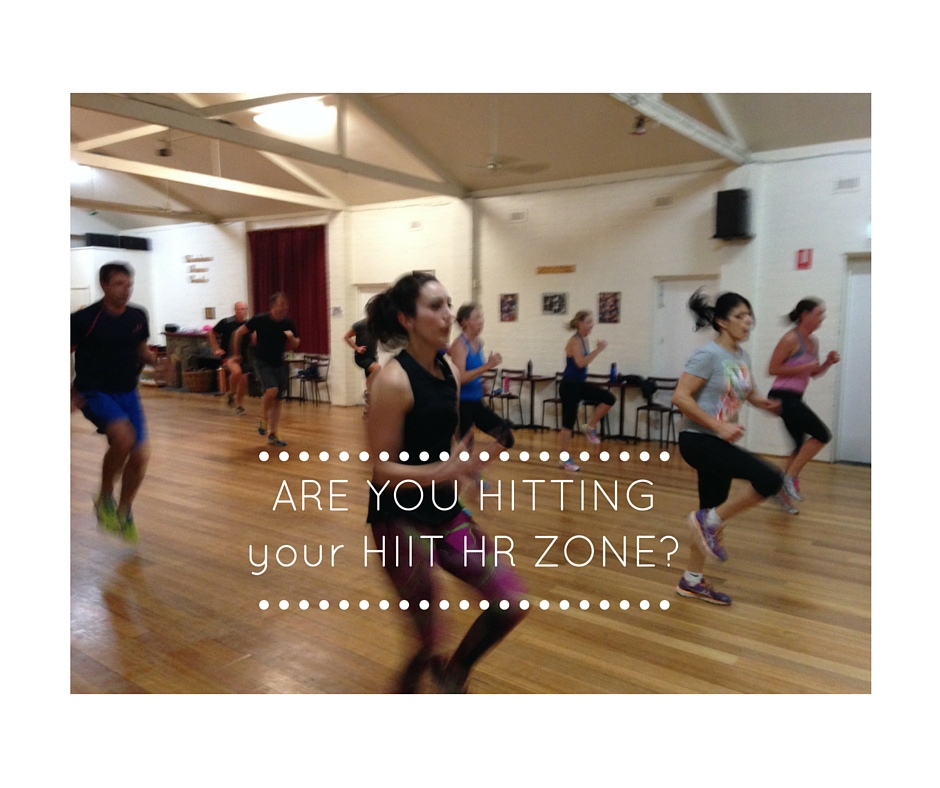
Are you hitting your HIIT Heart Rate zone?

Heart RateMetafit HR Training Zone – what is it & how to calculate it.

HEART RATE (HR) & INTENSITY – after a recent metafit session we had a little discussion about heart rate – what is the ideal HIIT or metafit HR training zone, how do you calculate Max HR and then training zones, my HR says xyz, is that good? etc – which prompted me to write this post. As lots of you have Fitbits or Garmins and the like with HR monitors built in – you may as well put them to good use! Here’s a little Heart Rate & Intensity 101…let’s put those fancy wrist adornments to work!

HEART RATE (HR) – the number of times your heart beats in a time period – we usually use a minute – and the unit of measure is BPM (beats per minute). With exercise your HR elevates as the heart works harder and beats faster to pump more blood around the body, to fuel the working muscles with oxygenated blood and remove waste products.

INTENSITY – this is a measure of how hard the body is working whilst exercising. Rate of Perceived Exertion (PRE) is the subjective scale you apply to measure intensity – for example going for a walk is probably a 2-3 out of 10 on a scale of 1 (super easy) to 10 (about to die hard!). HR is a measure of exercise intensity. The higher the HR or beats per minute, the higher the intensity or harder you are working.

MAXIMUM HEART RATE – This is the maximum your heart rate will reach during maximum physical exertion – beyond this you may run into problems. This number differs across age groups, physical fitness and genetics. For example a highly trained 45 year old will have a higher max HR to an untrained 45 year old. The standard formula for calculating Max HR is:

220 – your age = Max HR

Once you know your Max HR, you can then calculate the heart rate zones you should be working within to achieve the desired fitness outcomes of your training.

METAFIT HR TRAINING ZONE & INTENSITY – the ideal heart rate zone to be working within to get the most out of a metafit session is 80-85%. This is high when compared to moderate intensity endurance training, but that is why its called HIIT (HIGH INTENSITY interval training). Let’s use me as an example, my metafit HR training zone is:

220 – 45 (age) = 175 (my Max HR)
175 x 80% = 140
175 x 85% = 148.75
Metafit training zone: 140-150BPM

So, get the calculator out, calculate your Max HR and then your metafit training zone. Next time you do a session and you have your HR monitor on – keep an eye on it during the session and see if your perceived rate of exertion matches the actual HR you are working at.
I’d love to hear how you go – does your mind say you are working harder than your heart OR vice versa?

,

Spring into September


3-steps to spring into September

Spring into September

Spring…a time for new beginnings, a fresh start, a clean slate, a new wardrobe! Yes, we can (finally) leave winter behind and say a cheery Hello to longer days, brighter sunshine, and bare legs…well eventually (hopefully)!

So, just as a good spring clean for the house is on the to do list, I’ve also put together a little 3-step “spring into September” challenge. Not one of those nasty physical challenges that has you doing a gazillion burpees by the end of the month. This one has more of a recalibration feel to it…a shedding of the winter woollies and getting your butt into gear before we start singing Christmas carols and talking New Years resolutions.

3-steps to “spring into September”

  1. Move Daily

OK, so I know we all move daily – but I’m talking the type of movement that takes you further than the couch, fridge, office & car. MOVE for about 20 minutes a day – walk, swim, jog, ride, play tennis, play with the kids down the park, walk to school pick-up, try yoga or pilates – JUST MOVE.

  1. Eat Real Food

When trying to come up with a cool catchy phrase I couldn’t think of anything else but this. If you’ve been following me for a while, you’ll know I don’t subscribe to any fad diets, I just eat & promote wholesome, tasty, nutritious REAL food and keep it simple.

Here’s a few examples:

  • Home-made pizza over take away pizza – you get to choose your own toppings and its probably cheaper
  • 1 or 2 pieces of fresh fruit instead of a Boost Juice – definitely cheaper, will fill you up and give you an extra 10 -minutes in your day as you don’t have to wait in a queue
  • Salad & protein for dinner – so simple its ridiculous. Throw together a combination of anything you have in the crisper or pick up a few bits on the way home, add some feta, drizzle over some olive oil & freshly ground pepper and you have a salad. Serve that with a piece of steak, chicken or fish and you have just about the perfect balance of macro & micro-nutrients on your plate.
  • Eggs – cooked how you like, served with what you like, a complete meal in under 10 mins
  1. Connect socially

Social interactions and relationships are vitally important to our emotional and mental health & well-being. By connect I don’t mean via social media or electronically. I mean REALLY CONNECT – pick-up the phone and call a friend. And just talk. Make time to meet for coffee or lunch or breakfast or dinner. Go and visit your parents, grandparents, elderly relatives. Walk across the road and say Hi to a neighbour. Put screen devices (large & small) away/off at meal times and connect as a couple/family. Plan date nights with your partner, and girls/boys nights with your friends. Sounds like a fun month ahead!


So there you have it. It’s a tough challenge (!) but if you stick with it, you will be skipping and hopefully smiling into October.

Have fun

HB&S icons-19_web


Jac xx