Posts

,

Metafit for the midlife mumma?

Are you a 40+ female and looking for a new way to exercise that is short on time but big on results? If yes…read on!

If you’ve clicked on this post I’m going to presume you meet the following criteria:

  • Female
  • 40+
  • Currently exercising but not seeing results for the time or money you are devoting to it OR
  • Not exercising but would love to/need to start, but you don’t like gyms, and yoga and/or pilates don’t float your boat either OR
  • You feel a little intimidated to sign up to boot camp run by a 20 year old male trainer alongside his footy team-mates, but you love the idea of working hard and feeling the buzz after a tough session

If any of the above sound like you, then please read on…

OK, so I’m no stranger to pushing my body (& mind) to do heavy-duty physical things…in fact I met my hubby whilst sharing the chin-up bar at the gym!…so when I was introduced to METAFIT it was love at first sight! But doing old-school bodyweight exercises in short, intense bursts for 20 minutes until your legs are burning and you’re gasping for breath isn’t for everyone…or is it?

For the past 18 months I’ve been taking 7 metafit sessions a week. The overwhelming majority of my clients are women, and most of them would be north of 40 (or pretty close to). So why is metafit so attractive/addictive to the 40+ woman?

Here’s what I think:

It’s the RIGHT type of exercise for this age group (and I fit into this age bracket too). What do I mean by RIGHT type of exercise? Its INTENSE but SHORT, you feel ENERGISED afterwards and you GET RESULTS.

HOW? Because you:

  • Get HOT
  • Get SWEATY
  • Get OUT OF BREATH
  • Feel the LACTATE BURN in your muscles
  • Work in SHORT BURSTS
  • Work until you FEEL TRULY CHALLENGED and NEED TO REST
  • Use your own BODYWEIGHT – yep, the same weight that you drag around each day so you may as well use it!
  • FEEL yourself getting STRONGER and FITTER as you master exercises you thought a 40+ woman can’t/couldn’t/shouldn’t do! (Floor to sky tuck jump anyone?)

WHY should a 40+ woman do metafit or HIIT?

  1. BONE HEALTH – weight bearing and impact exercise are essential for bone health and maintaining bone mass at this critical phase of life. After the age of about 30, bone loss starts to outpace bone gain. In addition, the decline in oestrogen production that also occurs as we age has a negative impact on bone remodelling activity. Bone mass is reactive, not proactive. Bone must experience stress ie. load and impact, in order to remodel. Less stress = less remodelling = loss of bone mass.
  1. To build LEAN MUSCLE MASS (notice I say mass and not size) and therefore INCREASE YOUR METABOLISM – muscle tissue = metabolic tissue. The more (dense) muscle you have the higher your metabolic requirements – your body needs & will use more energy whilst at rest compared to someone who has less lean muscle.
  1. The high intensity of metafit promotes EPOC (excess post-exercise oxygen consumption) or the afterburn effect. Our bodies want to return to their resting state, but after being worked so hard during high intensity exercise, it takes considerable energy (calories) to do this. Even though the actual workout is only 30 minutes, the after effects are felt for many hours (up to 48hrs) afterwards.
  1. To MAINTAIN or INCREASE MOBILITY, BALANCE & POSTURE – the whole body functional nature of the exercises used in metafit see you getting up and down from the floor, moving forwards, backwards, sideways, using your arms and legs to push, pull, bend, lift, jump, hold etc through a full range of movement in all joints. At the same time your core & postural muscles are working to stabilise your torso and maintain posture. And the resistance is your own body – the same weight you drag around all day – nothing more, nothing less.
  1. Check the strength and integrity of your CORE & PELVIC FLOOR. If you find when you do burpees, sprints or jumps and pee your pants at ANY level…fantastic! This is 100% proof that your core/pelvic floor isn’t up to par for this type of training…yet. If this is you, please seek assistance from a specialised women’s health physiotherapist or your GP ASAP. Just like any muscles, these muscles can be trained to increase their strength and tone and your ability to control them. (Sometimes we need to experience a little of what we don’t want to do something about it!)

Are you a metafit or HIIT convert? How do you find it?

Curious to try? Come and join me at Heart Body & Soul in Glen Iris. You’ll find the timetable here. If you live a little too far away to visit me, search the Metafit Australia website for a coach near you.


,

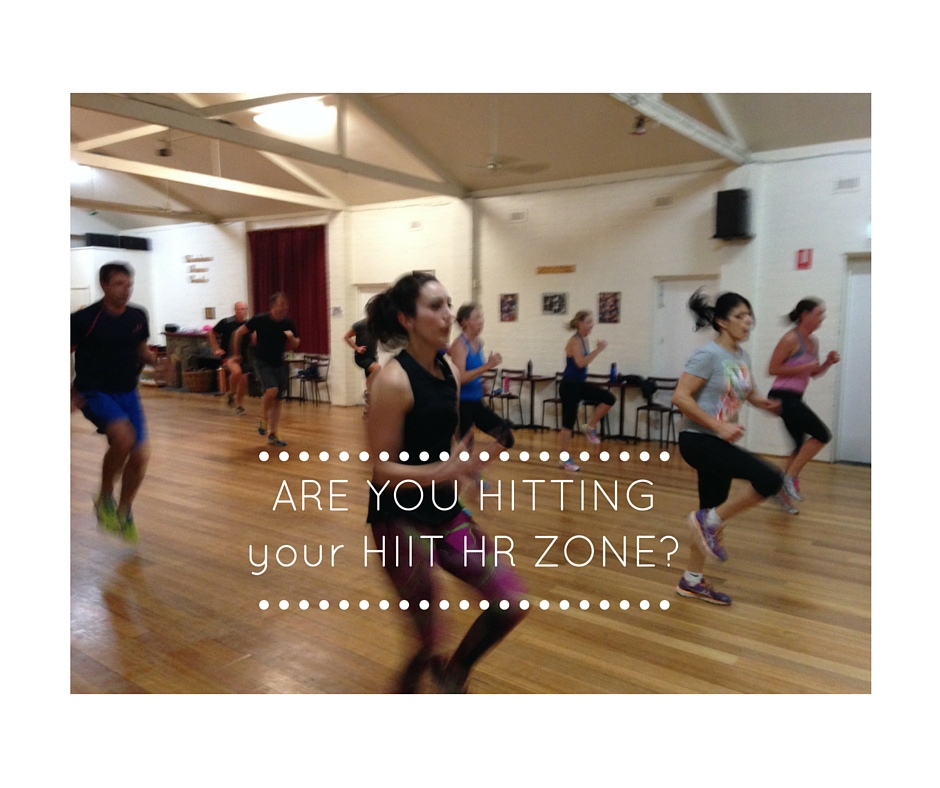
Are you hitting your HIIT Heart Rate zone?

Heart RateMetafit HR Training Zone – what is it & how to calculate it.

HEART RATE (HR) & INTENSITY – after a recent metafit session we had a little discussion about heart rate – what is the ideal HIIT or metafit HR training zone, how do you calculate Max HR and then training zones, my HR says xyz, is that good? etc – which prompted me to write this post. As lots of you have Fitbits or Garmins and the like with HR monitors built in – you may as well put them to good use! Here’s a little Heart Rate & Intensity 101…let’s put those fancy wrist adornments to work!

HEART RATE (HR) – the number of times your heart beats in a time period – we usually use a minute – and the unit of measure is BPM (beats per minute). With exercise your HR elevates as the heart works harder and beats faster to pump more blood around the body, to fuel the working muscles with oxygenated blood and remove waste products.

INTENSITY – this is a measure of how hard the body is working whilst exercising. Rate of Perceived Exertion (PRE) is the subjective scale you apply to measure intensity – for example going for a walk is probably a 2-3 out of 10 on a scale of 1 (super easy) to 10 (about to die hard!). HR is a measure of exercise intensity. The higher the HR or beats per minute, the higher the intensity or harder you are working.

MAXIMUM HEART RATE – This is the maximum your heart rate will reach during maximum physical exertion – beyond this you may run into problems. This number differs across age groups, physical fitness and genetics. For example a highly trained 45 year old will have a higher max HR to an untrained 45 year old. The standard formula for calculating Max HR is:

220 – your age = Max HR

Once you know your Max HR, you can then calculate the heart rate zones you should be working within to achieve the desired fitness outcomes of your training.

METAFIT HR TRAINING ZONE & INTENSITY – the ideal heart rate zone to be working within to get the most out of a metafit session is 80-85%. This is high when compared to moderate intensity endurance training, but that is why its called HIIT (HIGH INTENSITY interval training). Let’s use me as an example, my metafit HR training zone is:

220 – 45 (age) = 175 (my Max HR)
175 x 80% = 140
175 x 85% = 148.75
Metafit training zone: 140-150BPM

So, get the calculator out, calculate your Max HR and then your metafit training zone. Next time you do a session and you have your HR monitor on – keep an eye on it during the session and see if your perceived rate of exertion matches the actual HR you are working at.
I’d love to hear how you go – does your mind say you are working harder than your heart OR vice versa?

, ,

HIIT Workout for @ home or hotel

The latest DIY HIIT workout for @ home or the hotel room

One of the (many) brilliant things about HIIT bodyweight training is that a workout can be done anywhere at anytime – all you need is a little space, a clock with stopwatch or interval timer app, and a little self starter attitude.

The latest workout attached will take no more than 15 minutes including a warm-up!

So, what are you waiting for HIIT IT!IMG_0316.CR2

Hotel HIIT Workout #4

, ,

Focus on landing

Soft landings = safe landings

Metafit uses plyometric exercises (eg. jumps) to build strength and power. When performing plyometric exercises, landing technique is often overlooked, but it is AS if not more important than the concentric (upward) motion of jumping.

The untrained way to land is in a very rigid, stiff legged manner. As a result, all of the impact is absorbed between the hip, knee and ankle joints. It is much more advantageous to land softly and transfer the force to the glutes (butt), hamstrings, quads and calf.

One of the recent points of discussion in strength and conditioning communities focussed on people who are quad dominant v glute dominant. Quad dominant athletes tend to use their quads to shift their weight forward with squatting and jumping movements. This not only transfers a lot of pressure to the front of the knee, but puts a large load on the anterior cruciate ligament (ACL).

By learning how to land softly without noise and controlling deceleration, you will significantly lower the impact forces, decrease the risk of injury and extend the life of your joints.

The key points in landing technique are:

  1. Land as softly as possible, making no noise when the feet come into contact with the surface. How many times have you heard me say “Absorb the impact through your butt and thighs, not your joints”!
  2. Land flat footed or slightly heel first, keeping weight evenly distributed over the entire foot.
  3. Shift your glutes or butt back and keep your knees behind your toes. “Butt out”

Jumping and landing training are highly demanding on the nervous system, so it is essential that the body is warm enough to perform the exercises efficiently. Please practice these key points when performing jumps in a metafit session – your joints will thank-you.

, ,

Make time to exercise and make time for #1 – YOU

“How do I make time to exercise when I’m so busy”?

Life is BUSY, and being BUSY is IN –  who has time to exercise? Running from one appointment to the next, working longer hours, being switched on 24/7 via social media and smartphones, cramming more into each day. It’s not surprising then that the number one reason (excuse) given for not exercising is lack of time – exercise is usually the first thing given away to make more time for being BUSY.

You can still be busy AND make time to exercise. All it takes is a little PLANNING, a change in your MINDSET to make EXERCISE A PRIORITY, and a COMMITMENT to do it. It’s really important that mum’s (and I’m one who struggled with this, even being an endorphin junkie) let go of the guilt associated with devoting and investing time in yourself. If you don’t look out for #1, no-one else will. Set an example, be a role model, make time for YOU.

Here are a few tips on how to make time to exercise and look after #1.

  1. PLAN YOUR WEEK – we all run to a daily timetable. Alarm goes, morning routine, work/kids/errands, meals, and evening routine, bed. Just as we timetable in appointments with doctors, tradesmen, hairdressers, etc, make a daily appointment with YOURSELF to exercise. Add it to your daily/weekly schedule FIRST and build your day/week around that time.

HINT: Book all your METAFIT sessions for the week on a Sunday night, put them in the diary and work around them. (Sneaky link HERE to book)

  1. WAKE UP & WORK-OUT – I’m an early bird so getting up before the family to exercise has never been too hard (although in mid winter when its dark and cold it can be a challenge). But when my 3 kids were young and all at home, early was the only chance I had to exercise without little people in tow. If you’re not a morning person, getting up early can be a challenge but you can retrain your body clock – just persist.

HINT: Heart Body & Soul has 6am sessions Mon, Wed, Fri. You’ll be back home by 6.45!

  1. EXERCISE ON MOST DAYS OF THE WEEK – I love MEATFIT and the whole HIIT principle, but its NOT something that should be done more than 3 times a week, BUT that doesn’t mean do nothing the other days of the week! On your off days try an activity that gets your heart rate elevated, gets your body moving, lifting, and stretching. Tennis, swimming, running, a strength training session, or one of my favourites yoga – all great options that get you moving.
  2. LISTEN TO YOUR BODY – Some weeks you’ll be more tired, sore, maybe feel a head-cold coming on. Learn to listen to the messages your body is giving you and modify the planned exercise session accordingly. Maybe you had planned to do METAFIT but you aren’t feeling 100%, go for a walk instead and try METAIT the next day. Still plan for time to exercise, just change the activity to fit with your body’s message.
  3. SLEEP – probably THE most important part of your day. Without quality sleep we fail to function and thrive. Whilst the body is at rest it works to repair, restore, regenerate and absorb all that you have put it through whilst awake. Without rest the body is in a constant state of stress, and we all know what too much stress can do. Set a regular bedtime, SWITCH OFF mentally, electronically, and physically and rest. (Just set the alarm to wake up early before you fall asleep!!)

Do you have any tips on how to fit exercise and time for you into a busy schedule?


, ,

DIY HIIT Workout #5

TABATA – 4-16mins of HIIT

Tabata – is the name given to an exercise protocol developed by Prof. Izumi Tabata in a study he completed using Olympic speedskaters in 1996. The protocol is a version of HIIT (High Intensity Interval Training), 20 seconds of ultra-intense exercise followed by 10 seconds of rest, repeated for 4 minutes. The basics of this protocol are used in a variety of HIIT sessions, but in its purest form participants work at 150% Max HR for 4 mins total!

In this DIY workout YOU can be the coach – you get to choose how many Tabtata sets AND which sets to do. Each set is 4 minutes duration, alternating between 2 different exercises – 20 sec on A, 10 sec rest, 20 sec on B, 10 sec rest REPEAT.

As with all HIIT sessions, a thorough warm-up is essential, as is working HARD in each interval – you need to be huffing and puffing, NO PACING and GREAT TECHNIQUE. Exercise descriptions follow and the exercise basics can be found here

Warm-up:

Arm circles – back/forwards

Leg Swings – fwd & back, side to side

Trunk rotations

10 Body weight squats

5 Push-ups from knees

Jog on spot – butt kicks 15 sec, high knees 15 sec, sprint 15 sec – x 3 each

Main HIIT set:

TABATA – 20 sec work/10 sec x 8 = 4 mins per set

20 sec on ex A, 10 sec rest, 20 sec on ex B, 10 sec rest – REPEAT

30 sec rest in between sets

Set 1 A. Sliders/Skater B. Mt Climbers
Set 2 A. 2-step dash B. Crucifix plank
Set 3 A. Burpees B. No-wall sit
Set 4 A. Sprint B. Split hand push-ups


Sliders/Skaters –
Lower into squat position, step sideways keeping weight in heels and butt back, bring feet together, step to other side, feet together. Repeat. Stay low, head & chest up. 

Mt Climbers – In plank position (shoulders over wrists, heels over toes), bring one knee up to chest, return to plank position, repeat other side.

2-Step Dash – Run forward 2 steps, touch flat palm to ground, run back to steps, flat palm to ground. Bend at knees to keep butt down, squeeze butt to stand up, use arms in run phase.

Crucifix plank – wide arm plank, feet together, squeeze shoulder blades together

Burpees – old fashioned burpee. Hands on ground, jump feet back to plank position, jump feet in to hands, stand/jump up explosively with arms raised overhead. Repeat.

Split hand push-ups – One hand forward, one hand in normal push-up position, push-up, change hand position, repeat. From knees alternative.

Sprint – sprint on spot, high knees, pump arms

No-Wall Sit – Hold static squat for 20 sec. Butt back, weight in heels, head & chest up.


Cool Down:

Static stretches that target quads, hamstrings, hips, groin, lower back


,

Metafit – Child’s play for lasting benefits

Metafit – for a  long, healthy life

A metafit session may not be child’s play, but it does involve playful movements such as jumping up and down or standing on one leg, things we often leave behind with childhood. Yet these movements can benefit a grown-up’s body. Jumping can strengthen bones, and standing on one leg improves balance.

You don’t need to come to a metafit session to do either of these movements, but if you do come to metafit I guarantee you will do things you didn’t know you could (still) do. So, if its been a while since you jumped, stood on one leg or went outside your comfort zone, these are some of the reasons to give metafit a go.

A decade ago, a typical cardiovascular class (aerobics class) at a gym often involved so many choreographed moves you almost needed brains in your feet as well as your head. Now the trend that metafit leads is to less complex exercises that improve all-round physical function – not just aerobic fitness, but muscle strength, power, flexibility and bone density.

Old-school basic training, with movements such as push-ups, tuck jumps and burpees. Yes BURPEES – where you squat on the ground with your hands on the floor and kick your feet back so you are in a push-up position. Then jump your feet back into the squat position, jump up in the air and do it all again.

What is good about these movements is that, although they take effort, they are not complicated to do and, because you move quickly from one to another, there is no time to get bored.

“Traditional classes like step or aerobic classes have waned and I think its because the complexity of the choreography often compromised the physical benefits you got from them,” says Alisha Smith, education manager with Australian Fitness Network.

Metafit is functional training

Metafit is based on functional training, meaning exercises that target multiple muscles at once rather than just one muscle, such as a bicep curl. These movements are closely related to activities of daily living – think of how many times a day you move from sit to stand.

Now you don’t need to come to a metafit session to get fit, but one advantage of a class is that you generally work harder than when you are left to your own devices.  Metafit will also push you to vary your movements. Modern living can limit how we use our body. We walk a bit, sit a lot, don’t lift much weight and don’t jump. Yet research shows jumping is the most effective exercise for improving bone density, says Professor Robin Daly, chair of exercise and ageing at Deakin University.

Bones thrive on the stress and element of surprise that comes with jumping, he says. “We should include bone-loading activities like jumping, skipping and hopping. To improve bone density, it’s more important to vary the direction in which you jump than to keep jumping higher. Jumping from side to side is one way. So is a burpee.”

Metafit "explosive jack"

Bones thrive on the stress and element of surprise of jumping – a metafit “explosive jack”

“We don’t know exactly how much jumping is needed to improve bone density but our research suggests 50 to 100 multidirectional jumps three to five times a week.”

A lot happens in a 30 minute METAFIT session – some of the results of HIIT training are obvious in weeks, others not so obvious but have long lasting benefits for your health and well-being. Come and try a session – no fancy choreography, just old-school functional training that gets results.


,

DIY Workout #4

The 15/45 Workout

I’m going a little “retro” this week and bringing back the skipping rope. This is a fantastic piece of equipment to have in your collection. They are cheap ($3 from K-Mart), user friendly, transportable and best of all you can do a very effective and time efficient training session using them. This week’s workout combines 45 seconds of skipping with good old fashioned bodyweight exercises. Complete the set of exercises – should take around 5-7min – rest for 60 seconds, then repeat (a third time if your game too!)

Remember the key to making these sessions effective is to work hard – no pacing, no cheating on form – full movements.

Equipment: stop watch or timer, skipping rope

Warm-up:

Leg Swings – fwd & back, side to side

Calf/Achilles stretches

Trunk rotations

Jog on spot – butt kicks 15 sec, high knees 15 sec, sprint 15 sec – x 3 each

Main set:

Reps/Time Exercise Key Points
15 reps Body weight squats Legs shoulder width apart

Butt goes back as knees bend

Weight on heels

Head/chest up

Squeeze butt on way up

45 sec Skip OR Run on spot OR step ups Light on feet

Work hard & fast

15 reps In-out push-ups Full plank position, weight forward over hands

Hands wide, bend elbows chest to ground

Complete push-up

Hands in close, bend elbows to brush ribs, lower chest to ground

Complete push-up

Option – from knees

45 sec Skip OR Run on spot OR Step ups  
15 reps Reverse lunges Step one leg back

Lower back knee to ground

Keep chest upright & shoulders relaxed

Push through front heel back to start position

Change legs

45 sec Skip OR Run on spot OR step ups  
15 reps Get up planks Start in full plank position – heels over toes, shoulders over hands

Keeping butt down and core stable, lower down onto forearms – 1 arm at a time

Return back up to on hands. 1 rep

45 sec Skip OR Run on spot OR Step Ups  
15 reps Mountain climbers Start in full plank position

Keep butt down

Bring 1 knee under chest in between hands

Return to full plank

Change legs, continue

45 sec Skip OR Run on Spot OR Step ups  


60 Sec recovery – Repeat x 1-2

Cool Down: Static stretches that target quads, hamstrings, hips, groin, lower back


,

DIY Workout #3

This one is for those who like a “Cardio HIIT”

Just to keep you on your toes and add a bit of variety, this training session can be done on a spin bike, x-trainer, treadmill or out on the running track. Whichever you choose, remember to warm-up, work hard for the main set and cool down. Another 30 min session done and dusted!

Equipment: stop watch or timer – choice of bike, x-trainer, treadmill or the great outdoors

Warm-up:

Leg Swings – fwd & back, side to side

Calf/Achilles stretches

Trunk rotations

Main set:

00:00 – 05:00 min Steady warm-up, gradually increase resistance (bike/x-trainer) or pace (run/treadmill) to moderate intensity
05:00 – 15:00 min Sprint 20 sec, easy pace recovery 40 sec.

10 times total (10min)

15:00 – 19:00 min Hill climb 60 sec (gradually increase resistance or incline) – should feel hard. Stay seated if on bike. Recover with easy spin/jog 60 sec.

2 hill climbs (4min)

19:00 – 23:00 min Sprint 20sec, recover 10 sec. (If on treadmill jump onto edge of belt rather than decreasing speed)

8 times total (4min)

23:00 – 28:00 min Gradual cool down. Spin legs if on bike, decrease resistance on x-trainer or gentle jog on treadmill/run.


Cool Down: Static stretches that target quads, hamstrings, hips, groin, lower back


,

DIY Workout #2

Winter warmer

Winter has HIT! What better way to keep your exercise routine up even though the days have turned cold and miserable, than to turn your lounge room into a gym. All you need is a timer, an open door or window – trust me, you’ll need it – and a high energy music playlist. Remember to warm-up, work hard for the main set and cool down – you’ll be done in 30 minutes.

Equipment: timer (use timer function on smart phone or download an interval training app – there are many to choose from, play around with the settings to program work/rest intervals)

Warm-up:

Arm circles

Leg Swings – fwd & back, side to side

Trunk rotations

10 Body weight squats (concentrate on squeezing butt)

5 push-ups from knees

15 sec jog on spot, 15 sec high knees on spot, 15 sec butt kicks on spot, 15 sec sprint – Repeat x 3

Circuit: 30 sec break in between rounds

Round 1: 30 sec work/10 sec rest x 3

  1. Body Weight Squats – butt back, weight on heels, add a jump if feeling strong
  2. In-Out Push-ups – arms in close to brush rib cage for 1 push-up, hands out wide for 1 push-up, repeat
  3. Burpees with a turn – perform a normal burpee but jump 180 to complete second burpee facing opposite direction.

Round 2: 30 sec work/10 sec rest x 3

  1. Sliders – stay low in a squat, step sideways bring feet together, step back to other side. Key is to stay low, weight back on heels.
  2. Down & hold push-ups – lower chest to just off floor, hold for 3 sec, push-up, repeat. Do from knees if you can’t get chest low enough from toes.
  3. Burpees with split leg thrust – normal burpee but when you thrust legs back into plank position make v shape (legs wide apart), then complete as per normal

Round 3: 30 sec work/10 sec rest x 3

  1. Reverse lunges – step back into lunge, back knee to ground, change leg each time
  2. Walking push-up – in plank hold, take 2 steps sideways, perform push-up (drop to knees if needed), walk 2 steps back, perform push-up
  3. Burpees with sprint – perform a burpee then sprint on spot for 5, repeat

Round 4: 20 sec on/10 sec recovery x 8

  1. Sprint on spot OR skip with rope

Cool Down: Gentle walk & static stretches that target quads, hamstrings, back, arms, chest